
Running a mobile food business requires powering many devices at the same time – from refrigerators and freezers, through food preparation equipment, to lighting and ventilation. Properly selected equipment, a well-designed electrical system and a lightweight structure can help reduce operating costs and make everyday work easier.
Plan the Equipment and Its Layout
The first step towards saving energy in a food trailer is choosing equipment that matches the type of business and its actual needs. It is worth paying attention not only to the power consumption of individual appliances, but also to their placement. Refrigerators and freezers should not be located directly next to a grill, oven or fryer, as they may then consume more energy to maintain the required temperature.
A well-planned food trailer layout, proper ventilation and regular equipment inspections can help reduce unnecessary energy consumption.
Choose LED Lighting
One of the simplest ways to reduce energy consumption is to use LED lighting in a food trailer. LED lights consume relatively little energy while performing well during many hours of continuous operation.
It is also a good idea to divide the lighting into several independent zones, such as the work area, back-of-house area and sales area. Whenever possible, it is also worth making maximum use of natural daylight entering the trailer during the day.
A Lightweight Trailer Also Means Savings During Transport
Energy consumption should be considered more broadly – not only in terms of the equipment operating inside the trailer, but also its transport.
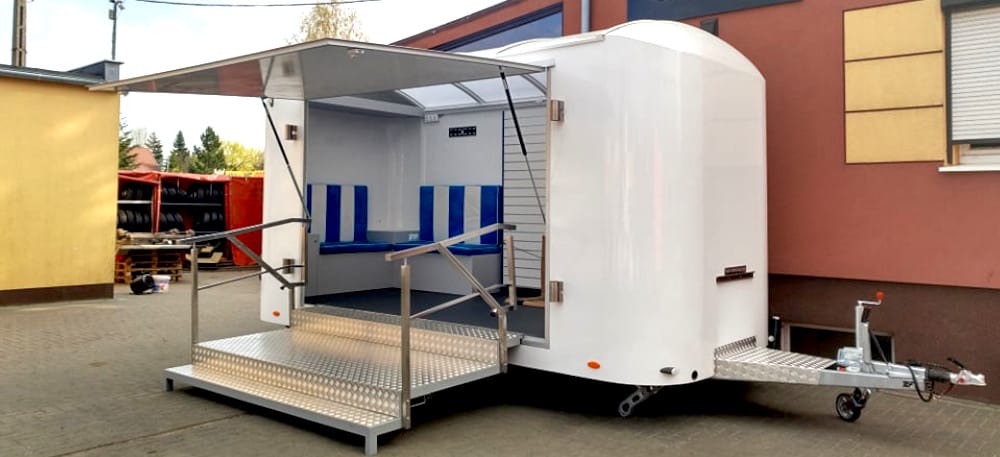
Thanks to WARK’s proprietary polypropylene processing technology, WARK trailers are characterised by a very low unladen weight. A lighter food trailer places less strain on the towing vehicle, which can result in lower fuel consumption during transport and, consequently, lower CO₂ emissions into the atmosphere.
This is particularly important in mobile catering, where the trailer regularly moves between events, festivals, trade fairs or seasonal sales locations.
For this reason, an energy-efficient food trailer is not only about appliances with low electricity consumption. A properly designed, lightweight and functional structure is equally important.
An Energy-Efficient Trailer Starts with the Design
The greatest opportunities for optimisation arise before the trailer even enters production. At this stage, the electrical system, appliance layout, lighting points, ventilation and power supply method can all be planned according to the nature of the business.
The better the design reflects the user’s actual needs, the easier it is to avoid unnecessary equipment, excessive energy consumption or an inconvenient layout.
Reducing energy consumption in a food trailer starts with a carefully considered design. The proper selection and placement of appliances, energy-efficient LED lighting, conscious use of equipment and a lightweight trailer structure can all help reduce the costs of everyday operation and transport.
It is therefore worth considering solutions at the planning stage that combine functionality, comfortable working conditions and lower energy demand.